Why Automation as a Service (AaaS) Is Replacing In-House IT in 2026
Is manual work draining your team's growth? Discover why Automation as a Service (AaaS) is quietly replacing costly in-house IT infrastructure in 2026.
Why Automation as a Service Is Quietly Replacing In-House IT in 2026
The $1.8 Trillion Problem Hiding in Plain Sight
Every growing business hits the same wall eventually.
At first, spreadsheets and email chains feel manageable. Then customer volume picks up, headcount grows, and suddenly your ops team is drowning in approvals, data entry, and copy-paste work that eats their entire week.
Here's the number that should stop you cold: businesses in the U.S. lose an estimated $1.8 trillion annually to repetitive manual tasks. On average, employees burn five hours every week on routine work that a machine could handle in seconds.
Five hours doesn't sound like much — until you do the math.
For a 100-person company, that's:
- 500 lost work hours per week
- 26,000+ wasted hours per year
- Thousands of dollars in avoidable productivity loss
And the damage doesn't stop at the bottom line. Manual-heavy operations create slower customer response times, higher error rates, and — eventually — real burnout in the people you're relying on most.
For decades, the standard fix was building an internal IT team and writing custom automation solutions. But that model is breaking down fast. In 2026, a fundamentally different approach is taking over: Automation as a Service (AaaS).
### 💡 Quick Takeaway
– Businesses lose $1.8 trillion/year to manual work — the problem is bigger than most realize
– AaaS delivers enterprise-grade automation on a subscription model, no internal infrastructure required
– Companies adopting AaaS are seeing cost reductions of 20–50% and CSAT scores approaching 90%
What Is AaaS, Really? (And Why It's Not Just Another Tech Acronym)
Automation as a Service is a cloud-native delivery model that gives businesses access to powerful automation capabilities through subscription-based platforms — without having to build or maintain anything themselves.
Think of it like electricity.
You don't build a power plant to keep the lights on. You plug in, pay for what you use, and focus on running your business. AaaS works the same way: instead of spending months developing custom automation infrastructure, you subscribe to a platform that already has it built.
It's the natural evolution of SaaS. Just as SaaS killed the need for on-premises software servers, AaaS eliminates the need for internal automation teams, custom-built integrations, and expensive upkeep.
What does that actually look like in practice? These platforms typically include:
- Workflow and business process automation
- API integrations and data synchronization
- AI-powered decision-making
- Document processing and reporting
- Customer service automation
Here's what most people miss about AaaS: it's not just about efficiency. It's about access. For years, sophisticated automation was exclusively the territory of large enterprises with eight-figure IT budgets. Today, a 10-person startup can access the same capabilities as a Fortune 500 company. That democratization is one of the most significant business shifts happening right now.
Why In-House IT Can't Keep Up Anymore
Look, in-house IT served its purpose. For a long time, it was the only option.
But the model is increasingly difficult to justify — and here's why organizations are walking away from it.
The talent problem is real. Hiring skilled professionals in automation engineering, cloud architecture, DevOps, API development, and AI isn't just expensive — it's a full-time job in itself. And once you find those people, keeping them is another challenge entirely.
Infrastructure costs compound fast. Servers, networking, security systems, monitoring tools, integration platforms — these aren't one-time purchases. They're ongoing commitments that keep growing as your needs change.
Internal teams get stuck maintaining, not building. This one's critical. Most in-house IT resources end up spending the majority of their time keeping existing systems alive rather than creating new value. Meanwhile, competitors are moving faster.
Scalability is baked into cloud, not into custom builds. Many internally built automation systems are designed around what the business looks like today. When growth happens — and it always does — those systems often require costly redesigns that could've been avoided entirely.
AaaS solves all four of these problems at once. That's why the shift is accelerating.
Forget the "Project" Mindset — It's Time to Think in Products
Here's a distinction that separates the companies getting real results from automation vs. the ones spinning their wheels.
Most organizations historically approached automation as a project: a one-time initiative with a clear start and end date. Automate invoice processing. Deploy a reporting dashboard. Done — ship it and move on.
That thinking is outdated.
The organizations winning with automation in 2026 treat it as a product: something that evolves continuously, gets measured against real business outcomes, and improves over time.
Instead of asking "How do we automate this task?" they're asking "How do we continuously improve this process?"
Success isn't measured by deployment. It's measured by:
- Customer satisfaction
- Operational efficiency
- Revenue growth
- Employee productivity
- Business agility
This mindset shift matters because AaaS platforms are built exactly this way — they update continuously, add new integrations, and expand capabilities without you having to do anything. The technology grows with you.
RPA vs. AaaS: These Are Not the Same Thing
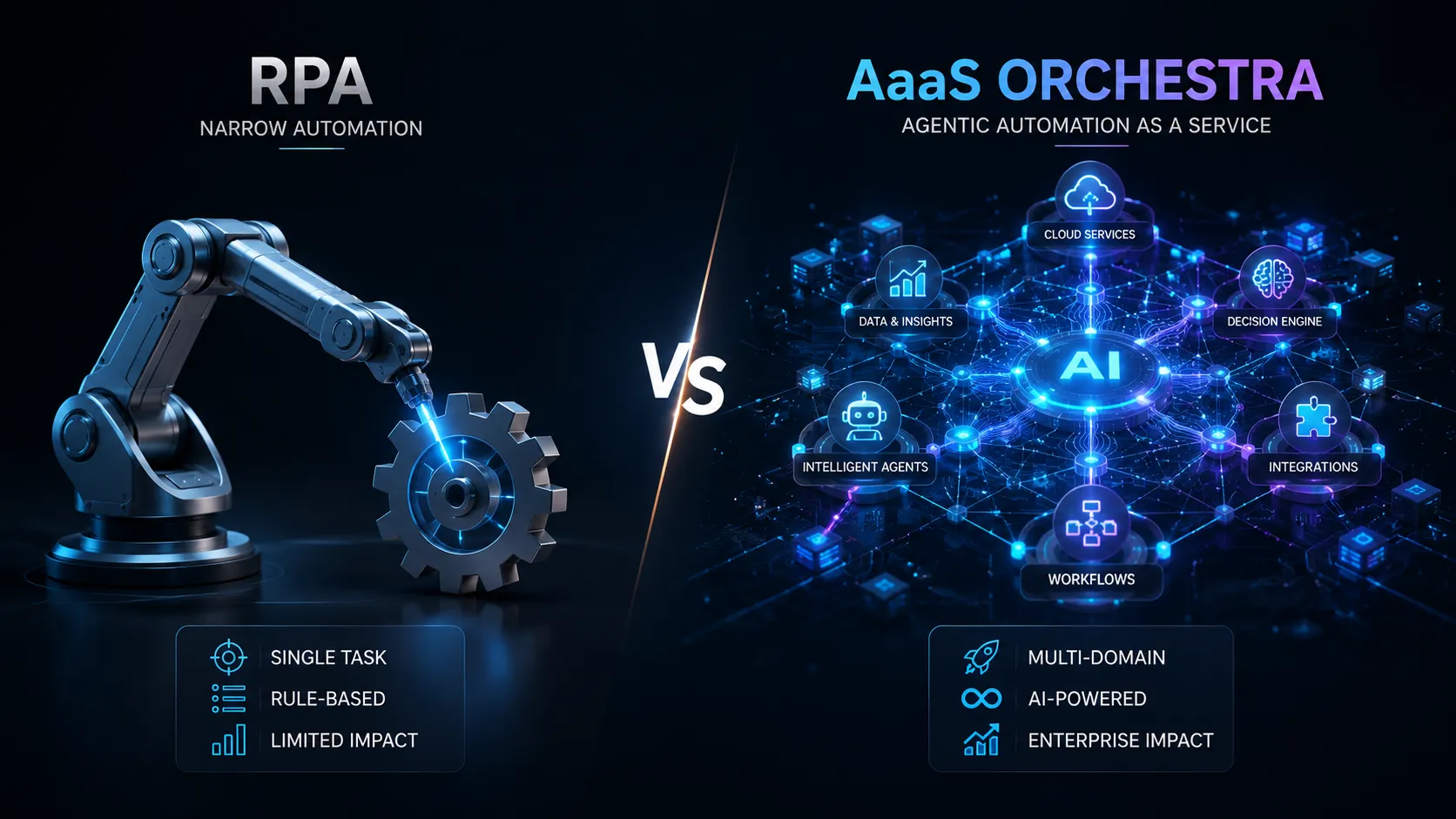
If you've been treating Robotic Process Automation and Automation as a Service as interchangeable, it's worth clearing this up — because the difference has major implications for how you plan.
RPA is powerful but narrow. It uses software bots to automate repetitive, rule-based tasks: data entry, form processing, CRM updates, invoice handling. Fast, consistent, reliable — for the specific jobs it's designed to do.
AaaS is the full ecosystem.
It includes RPA, but layers in:
- Workflow orchestration
- API management
- AI Agents
- Analytics and reporting
- Cloud infrastructure
- Decision intelligence
- Process governance
Here's the simplest way to think about it: RPA is a single instrument. AaaS is the orchestra.
If you're running a small, isolated process, RPA might be all you need. But if you're serious about digital transformation at scale, you need the broader platform.
The Technical Core: What's Actually Running Under the Hood
Don't let this section scare you off — understanding the fundamentals makes you a smarter buyer and a better strategic partner.
Service Orchestration
Orchestration is about coordinating multiple systems into a unified, seamless process. Consider a single e-commerce purchase. That one transaction typically triggers inventory validation, payment authorization, warehouse notification, shipping label generation, customer communication, and accounting updates — all in sequence.
Without orchestration, those systems run independently and inconsistently. With it, they work like a single machine.
Service Orchestration and Automation Platforms (SOAP)
In 2026, leading organizations are adopting SOAP — centralized automation hubs that manage workflows across cloud apps, legacy systems, DevOps environments, data pipelines, and security platforms. The result is better visibility, tighter governance, and far more operational consistency.
Deterministic Process Execution
This one matters especially in regulated industries. Deterministic Process Execution means automated workflows run exactly as designed, every single time — no variation, no interpretation. That's non-negotiable for compliance audits, identity verification, insurance claims, and financial transactions where a single deviation can mean a regulatory penalty.
The Business Case: What the Numbers Actually Say
So does it work? Let's look at the data.
Organizations implementing automation initiatives frequently report operational cost reductions of 20% to 50%. Savings come from reduced labor costs, lower infrastructure spend, fewer errors, and faster process execution.
On the productivity side: when employees stop spending five hours a week on repetitive tasks, they redirect that time toward customer engagement, strategic work, and revenue-generating activities — the things that actually move the needle.
And on the customer side? Mature automation implementations regularly see CSAT scores approaching 90%. Faster response times, fewer errors, and more consistent experiences add up quickly.
The scalability benefit is worth emphasizing too. Cloud-based platforms scale horizontally — meaning when your business grows, you expand automation capacity on demand, without touching a single server rack.
Real Industries, Real Results
This isn't theoretical. Automation as a Service is delivering measurable outcomes across sectors right now.
E-Commerce: Brands like Tropicfeel use automation to manage inventory sync, order fulfillment, customer communication, marketing campaigns, and returns processing — enabling rapid growth without proportionally scaling headcount.
IT Operations: Automated incident management handles system monitoring, alert routing, ticket creation, and root cause analysis. Less downtime, faster resolution.
Human Resources: Onboarding, documentation collection, compliance workflows, benefits administration — all automated, creating a dramatically smoother employee experience with less administrative overhead.
Healthcare: Appointment scheduling, claims processing, patient communications, and regulatory compliance workflows are all prime candidates for automation.
Insurance: Claims management, fraud detection, customer service, and policy administration — industries that deal in high-volume, rule-heavy processes are seeing some of the strongest ROI from AaaS adoption.
The Role Most Companies Overlook: The Automation Architect
Here's what most companies get wrong when they first invest in automation: they assume buying the software is the hard part.
It isn't.
Successful automation programs need strategic leadership — someone who serves as the bridge between business goals, operational processes, technology platforms, and AI systems. That person is an Automation Architect.
Their job isn't just technical. They identify the highest-value automation opportunities, design the workflow architecture, manage integrations, build governance frameworks, and measure business outcomes.
Without this role, organizations end up with a patchwork of disconnected automations that don't talk to each other and don't deliver meaningful ROI. It's a common and expensive mistake.
Automation success depends on architecture, not just technology. Keep that in mind when building your team.
How to Get Started: A Practical Six-Stage Roadmap
If you're ready to move, here's how successful AaaS implementations typically unfold:
- Use Case Identification — Start with repetitive, high-volume tasks that deliver clear, immediate value when automated.
- Process Mapping — Document your workflows. Find the bottlenecks. You can't automate what you haven't clearly defined.
- Platform Selection — Evaluate vendors on security, scalability, integration depth, AI functionality, and total cost of ownership. Don't let a slick demo substitute for due diligence.
- Build and Integration — Connect systems through APIs, connectors, and automation frameworks.
- Testing and Optimization — Validate performance, accuracy, and compliance before you go live.
- Monitoring and Support — This is where the "product mindset" pays off. Continuously refine based on real performance data and evolving business needs.
What's Next: AI Agents and the Move Toward Agentic Automation
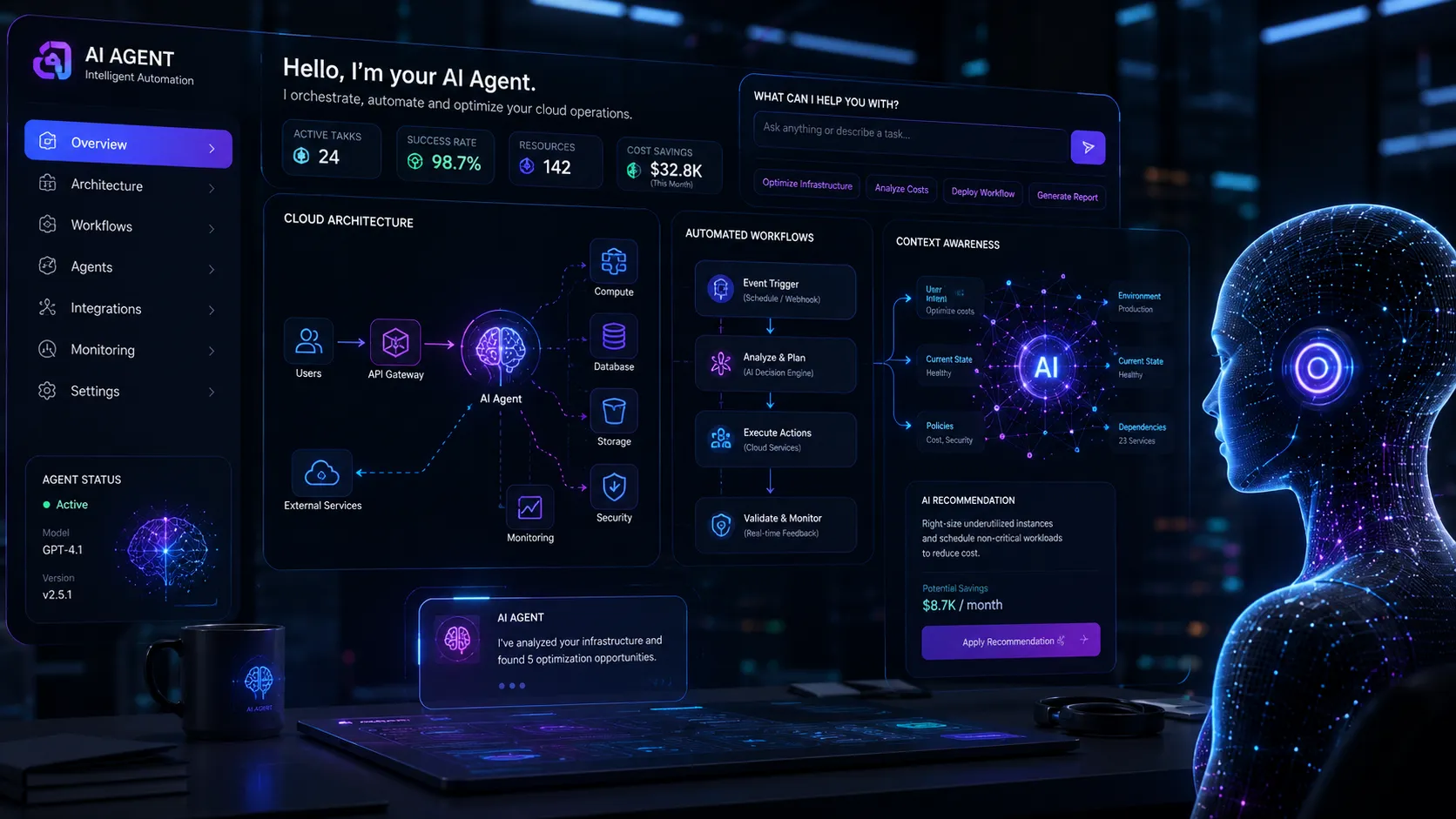
Traditional automation follows rules. AI Agents follow context.
The next evolution of AaaS is already being deployed. Rather than simply executing a predetermined set of instructions, AI Agents can analyze context, retrieve relevant information, make decisions, coordinate workflows, and adapt to changing circumstances — all without a human in the loop.
This shift is what people are calling Agentic AI. Platforms are starting to roll out intelligent systems capable of handling complex processes that previously required human judgment at every step.
The future of automation isn't about automating tasks. It's about automating outcomes.
The companies investing in AI Agents now are building a competitive advantage that's going to be very hard to close in two or three years.
So Here's the Takeaway
The business environment in 2026 rewards speed, agility, and operational efficiency. The traditional in-house IT model — with its talent shortages, rising infrastructure costs, and slow innovation cycles — struggles to deliver all three.
Automation as a Service offers a different path: enterprise-grade automation, delivered through the cloud, without enterprise-level complexity. Cloud platforms, SOAP orchestration, AI Agents, and strategic Automation Architect leadership — these aren't abstract concepts anymore. They're the building blocks of how the most competitive businesses are operating right now.
The companies that thrive in the next decade won't necessarily have the largest IT departments. They'll have the smartest automation strategies.
For SMBs, the question isn't whether AaaS is the future. It's how quickly you can move before your competitors do.
Ready to Stop Losing 5 Hours a Week Per Employee?
If this hits close to home — if your team is still buried in manual work that should've been automated yesterday — let's have a real conversation.
[AutomationFunda.com] helps SMBs implement Automation as a Service without the headache, the overhead, or the six-month IT project that never quite delivers. We handle the architecture, the integration, and the ongoing optimization so your team can focus on work that actually matters.
No jargon. No fluff. Just working automations.